Your radiologists cannot see a scan taken at another site without a workaround. Every new clinic, imaging center, or partner hospital adds another silo of studies, another login, and another gap in patient history.
This guide explains how to evaluate a cloud PACS for multi-site access in 2026. You will learn what Medicai offers, which features matter for connected sites, how pricing works, and how to decide whether it fits your organization.
What Is Medicai? Cloud PACS Built for Multi-Site Imaging
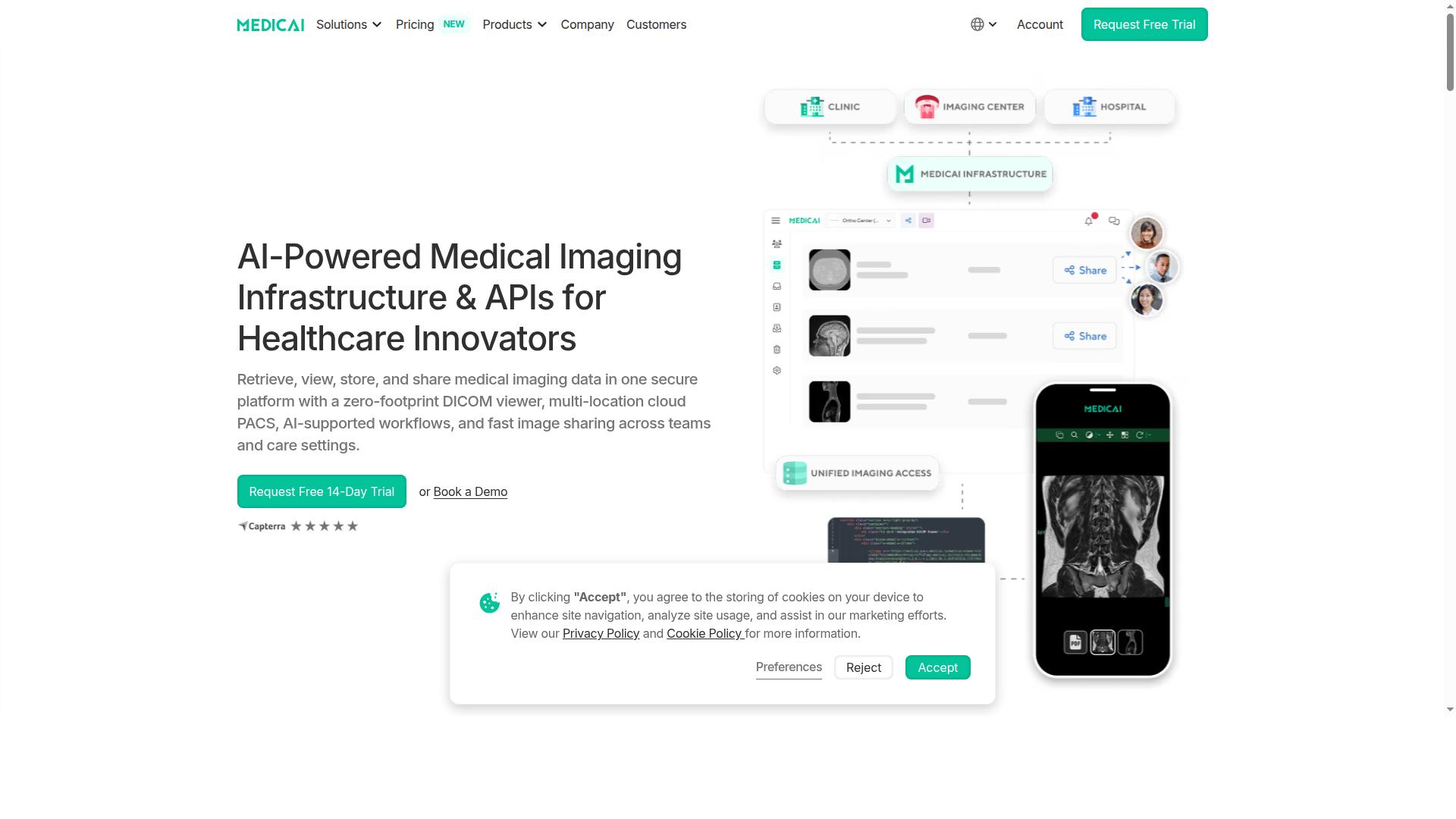
Medicai is a cloud-based medical imaging platform that enables healthcare providers to retrieve, view, store, and share medical imaging data in one secure platform with a zero-footprint DICOM viewer. In practical terms, it is a SaaS PACS delivered over the internet, so imaging teams can work from any connected location without maintaining on-premises server hardware.
The platform's core purpose is unifying imaging data across multiple sites. Instead of each facility running its own isolated picture archiving and communication system, Medicai brings studies into a single cloud environment where radiologists, referring clinicians, and care teams can access the same images.
Medicai also provides Imaging Infrastructure as a Service (IIaaS) and is a VC-backed healthcare startup focused on modernizing medical imaging workflows and enabling interoperability. That positioning matters for buyers evaluating a 2026 cloud migration, because it signals a product built around connectivity rather than a legacy system retrofitted for the cloud.
The zero-footprint DICOM viewer is a key differentiator. It runs without local installation, which simplifies access for distributed reading teams and supports teleradiology use cases where radiologists work across sites or remotely.
Beyond the viewer, Medicai combines a multi-location cloud PACS, AI-supported workflows, and fast image sharing across teams and care settings. For a multi-site organization, these capabilities address the everyday friction of routing studies, coordinating reads, and getting images to the clinicians who need them.
Security and compliance are central to the platform. Medicai is HIPAA and GDPR compliant and offers FDA/CEE cleared viewers, which are baseline requirements for any cloud PACS handling patient imaging data across jurisdictions. Buyers should still verify current certifications and data residency options during due diligence.
In short, Medicai is best understood as a cloud-native answer to a common multi-site problem: fragmented imaging systems that slow down radiology workflow and limit image exchange. Its combination of SaaS delivery, a browser-based diagnostic viewer, and interoperability focus makes it a relevant option to weigh in this buyer's guide.
Why Medicai Is a Strong Choice for Multi-Site Cloud PACS Access
Multi-site healthcare organizations face unique challenges in imaging data management, and Medicai addresses these with an architecture designed for connected locations and seamless access. The platform brings medical imaging upload, storage, exchange, and viewing into one cloud environment, so a hospital network or imaging center chain can manage studies centrally instead of juggling separate on-premises PACS at every site.
For buyers weighing options in this 2026 buyer's guide, the appeal comes down to three things: centralized access to images across locations, room to scale as new sites join, and a lighter IT burden than maintaining servers and storage at each facility. Medicai reports 70 clinics and hospitals on the platform and more than 2M imaging studies uploaded, which shows the model working across real multi-site footprints.
The subsections below detail the architecture and security credentials behind that value proposition, from how connected sites exchange DICOM data to the compliance and interoperability standards that matter in a multi-site rollout.
Multi-Location Architecture and Connected Sites
Medicai's architecture supports multiple connected locations, enabling seamless image exchange and centralized management across sites. Each site feeds studies into the cloud through the DICOM Gateway, which handles data ingestion from modalities and local systems, while cloud storage and the Cloud PACS hold and organize those studies for access from any connected location.
The Standard plan includes one connected location, and higher tiers are structured to support organizations operating across more sites. Buyers planning a network rollout should confirm the connected-location count for their tier during evaluation, since that number shapes how many facilities can share one imaging environment.
For distributed sites, performance depends on how the platform handles distance and network conditions. A hospital network can route studies from a satellite imaging center to a central reading team, and an imaging center chain can give every branch the same view of prior studies.
Medicai's broader platform supports this pattern with a Vendor Neutral Archive, Medical Image Exchange, and Backup and Disaster Recovery. For teleradiology groups and enterprise imaging programs, that combination means one connected environment rather than a patchwork of site-level systems.
Security, Compliance, and Interoperability Credentials
Medicai prioritizes security and compliance, holding HIPAA and GDPR compliance and FDA/CEE cleared viewers. The platform follows OWASP security guidelines, and its Microsoft Azure partnership underpins the cloud infrastructure that multi-site organizations depend on for uptime and data protection.
Core controls cover the areas buyers scrutinize most in a Cloud PACS evaluation:
- Encryption at rest and in transit to protect studies in storage and during image exchange between sites
- Role-based access control (RBAC) so staff at each location see only the studies and functions their role requires
- Single sign-on (SSO) to simplify logins across a distributed workforce
- Audit trails that record access to patient imaging for compliance reviews
On interoperability, Medicai supports HL7, FHIR, IHE profiles, and XDS, which matters when a multi-site organization needs its picture archiving and communication system to work together with EHRs and other clinical systems. Data residency options in the US and EU help organizations meet regional rules, a key consideration for networks operating across borders.
These credentials pay off in daily operations. A multi-site group can give a tumor board at one hospital access to studies from another under controlled permissions, while audit trails document every view. Teleradiology teams can sign in once through SSO and work across locations without separate credentials. For buyers comparing vendors, this combination of HIPAA compliance, GDPR alignment, encryption, and standards-based interoperability is the foundation a multi-site Cloud PACS needs, and Medicai delivers it as part of the platform.
Key Features and What Makes Medicai Stand Out
Medicai offers a suite of features designed to streamline radiology workflows and enhance collaboration across teams and sites. For a multi-site organization weighing a Cloud PACS in 2026, the differentiators that matter most are the ones that touch daily reading, data unification, and business continuity.
Four capabilities sit at the center of the Medicai platform: a zero-footprint DICOM viewer, AI-supported workflows, a vendor-neutral archive (VNA), and backup and disaster recovery. Each addresses a distinct pain point that buyers typically hit when extending imaging beyond a single hospital or clinic.
These features also map cleanly onto the evaluation criteria covered earlier in this guide, including interoperability, uptime, and secure image exchange. The subsections below explore each one in detail so you can judge fit against your own multi-site requirements.
Zero-Footprint DICOM Viewer and Image Sharing Across Teams
The zero-footprint DICOM viewer allows radiologists and clinicians to access and manipulate images directly from a web browser without installing software. That removes a common friction point in multi-site setups, where workstations at different locations often run different software versions.
Because access happens through the browser, a radiologist at a central hub can open studies from a remote clinic without a local install or a site visit from IT.
Sharing extends beyond the radiology department. The Medical Image Sharing Platform and Doctor Imaging Portal support collaboration across teams and with external referrers, while the Patient Imaging Portal gives patients a route to their own images. Medicai states that its viewers are FDA and CEE cleared and supports teleradiology, which matters when reads cross site and regional boundaries.
Consider a hub-and-spoke network: a radiologist at the main hospital reads a study from a satellite clinic the same way they would read a local case. No software deployment, no courier, no delay waiting for images to arrive on a disc. For organizations planning a cloud migration, that workflow is often the fastest visible win.
AI-Supported Workflows, VNA, and Backup/Disaster Recovery
Medicai integrates AI tools and provides a vendor-neutral archive (VNA) along with robust backup and disaster recovery to future-proof imaging data management. Together these cover three concerns that multi-site buyers raise again and again: triage speed, data fragmentation, and continuity.
On the AI side, Medicai works with partners including MD.ai and Rayscape.ai, alongside its Radiology AI Co-Pilot and AI-Powered Diagnostics offerings. These can support triage and analysis within the radiology workflow, helping teams prioritize and interpret studies. Buyers should confirm which AI tools fit their clinical priorities and how results surface to readers.
The VNA unifies data from multiple PACS and modalities into one archive. For an organization running several on-premises PACS across sites, that means a single place to consolidate studies during or after a cloud migration, rather than maintaining separate silos per location.
Backup and disaster recovery support business continuity. For multi-site groups, this means that if one site's systems fail, imaging data remains accessible. The YTS-Dental View case illustrates the multi-site payoff, with 10 locations across Romania integrated and 90% less time to access patient studies.
Pricing and Plans for Multi-Site Buyers
Medicai offers transparent monthly pricing with plans starting at $249 per month for 500 GB of cloud storage and unlimited user accounts. For a multi-site imaging network, the most important question is not just the sticker price but how each plan maps to your storage volume, the number of connected locations, and the way studies move between them.
Two published tiers cover most smaller and mid-sized operations, with custom enterprise pricing for larger networks. Here is how the plans compare on cost and capacity.
| Plan | Monthly Price | Yearly Billing (15% savings) | Cloud Storage | Connected Locations |
|---|---|---|---|---|
| Starter | $249/month | $209/month paid yearly | 500 GB | No connected locations |
| Standard | $749/month | $639/month paid yearly | 2 TB | One connected location |
| Enterprise | Custom pricing | Custom pricing | Custom cloud storage | Multiple connected locations |
Both Starter and Standard include unlimited user accounts, so the cost of adding radiologists, technologists, or referring clinicians does not rise with headcount. The dividing line between tiers is storage and connected locations, not seats.
Multi-site buyers should weigh three cost drivers before choosing a tier. First, storage needs: estimate annual study volume and growth, since a network that outgrows 500 GB quickly will want the 2 TB Standard tier or a custom enterprise allocation. Second, number of connected locations: Starter supports no connected locations, while Standard supports one, so a two-site practice already needs enterprise pricing. Third, add-ons: DICOM Gateway Setup is $1,000 one-time per location, a cost that scales directly with the size of the network.
Yearly billing changes the math meaningfully. Paying annually brings Starter to $209 per month and Standard to $639 per month, a 15% savings that compounds across a multi-year deployment. For a network planning a long-term cloud migration, committing yearly lowers the effective cost per location. A free 14-day trial of Starter plan features is included, with no credit card required, which lets a team evaluate the platform before committing budget.
Compared with an on-premises PACS, cloud pricing is easier to forecast. On-premises systems carry server hardware, storage expansion, refresh cycles, and IT labor that are often hard to predict. A SaaS PACS converts much of that into a fixed monthly figure, which simplifies budgeting across sites. Refunds are not available for partial periods, so buyers should match billing terms to their rollout timeline.
For hospital groups and larger imaging networks, enterprise plans provide custom cloud storage and multiple connected locations, plus multiple external locations for image exchange. Per-study pricing is also available for enterprise customers, which can suit high-volume or seasonal workloads. The right choice for a multi-site buyer is the tier whose storage and location limits match the network's actual footprint, with enterprise pricing reserved for organizations that need room to grow across many sites.
Trust Signals: Track Record, Partners, and Testimonials
Medicai has processed over 1 million studies per year and stores more than 1.7 million studies, demonstrating its reliability at scale. For a buyer weighing Cloud PACS options in 2026, those numbers matter more than a feature list. They show the platform handles real clinical volume, not just pilot projects.
Scale is one signal. Breadth of adoption is another. Medicai serves 70 clinics and hospitals with more than 10,000 active doctors on the platform, and over 2 million imaging studies have been uploaded to date. That mix of sites and users is exactly what a multi-site imaging network should look for.
Volume alone does not prove a system is fast or stable. But sustained throughput across many organizations suggests the architecture holds up under daily use. It also means the vendor has seen a wide range of radiology workflow patterns, from single-hospital groups to distributed teleradiology operations.
Platform Metrics That Show Operational Depth
Beyond study counts, Medicai publishes figures that speak to how the platform is actually used. In the last year alone, users viewed 300k+ DICOM study visualizations. That points to active diagnostic reading, not just archival storage.
The platform also handles 50M+ yearly API transactions. High API volume signals real integration activity, which matters when you connect a Cloud PACS to HL7 and FHIR feeds, modality worklists, and other enterprise systems. A system that only stores images is a silo. One that exchanges data through APIs is closer to a true vendor-neutral archive.
These metrics are useful during due diligence. Ask any vendor how many studies they transact annually, how many sites run on the platform, and how much API traffic they support. Concrete answers separate a mature SaaS PACS from a newer entrant.
Partners and Ecosystem Credibility
Medicai's partner list includes Microsoft Azure and Amazon AWS, alongside MD.ai and Boehringer Ingelheim. Cloud infrastructure partnerships matter for hybrid cloud and cloud migration planning, because they indicate where workloads run and how data residency can be arranged.
Partnerships with AI and life sciences organizations point to interoperability beyond basic image storage. For a multi-site buyer, that suggests the platform can support image exchange and research-adjacent workflows, not just routine reading.
Medicai has also been featured in press for enabling global multidisciplinary tumor boards and for helping Ukrainian refugee patients access cancer treatments. Those stories show the platform working across borders and care teams, which is directly relevant to multi-site access.
Compliance, Security, and Uptime as Trust Factors
Compliance is non-negotiable in medical imaging. Medicai is HIPAA and GDPR compliant, offers FDA/CEE Cleared Viewers, and follows OWASP security guidelines. Together these cover the core concerns of a 2026 buyer: patient data protection, cleared diagnostic tools, and a documented approach to application security.
Security controls to confirm during evaluation include encryption at rest and encryption in transit, role-based access control, single sign-on, and a reliable audit trail. Ask how each is implemented and whether it is standard or optional. A vendor that answers clearly on all four is easier to trust with multi-site data.
Uptime matters just as much. A Cloud PACS that goes down interrupts reading across every connected site at once. Review the uptime SLA, how downtime is communicated, and what happens to in-progress reads during an outage. Pair that with latency and bandwidth testing on a zero-footprint viewer before signing.
What Typical Customer Outcomes Look Like
Medicai reports that its platform reduces diagnosis time by 65%. For a multi-site network, faster turnaround affects reporting queues, patient communication, and referral relationships. It is the kind of outcome buyers should ask about in reference calls.
When you speak with existing customers, focus on questions tied to multi-site access. How quickly can a new site be onboarded? Does study routing work across locations? Do clinicians get consistent access to prior studies regardless of where they were acquired?
- Ask how long the site has used the platform and what volume it handles
- Confirm the experience with interoperability, including HL7 and FHIR integrations
- Ask about viewer performance over real-world bandwidth conditions
- Request details on support responsiveness and issue resolution
The verdict for this section is straightforward. Medicai backs its multi-site Cloud PACS claims with measurable volume, recognized partners, and clear compliance commitments. For a 2026 buyer, that combination is a strong trust signal worth weighing seriously.
Who Should Use Medicai
Medicai is designed for healthcare providers including hospitals, imaging centers, and specialty care practices that need multi-site imaging access. The platform fits organizations where imaging studies are generated or reviewed across more than one location, and where fragmented systems slow down clinical decisions.
Because it is a SaaS PACS delivered online, Medicai removes the burden of maintaining separate on-premises infrastructure at every site. Teams reach images through a browser-based workflow, which matters when radiologists, referring physicians, and care teams are spread across buildings or regions.
Below are the main customer profiles and the specific reasons each one benefits from a centralized cloud approach to medical imaging.
Multi-site hospital networks. Large networks often run different PACS instances per facility, which creates silos and duplicated storage costs. Medicai gives these organizations one place to manage studies across sites, supporting centralized access and a more consistent radiology workflow. Enterprise imaging teams also gain a clearer path for cloud migration without replacing every local system at once.
Imaging center chains. Chains that open new locations need imaging access that scales with growth. A SaaS PACS lets each new center connect to the same platform rather than standing up its own archive. That supports scalability and helps control the cost of repeated infrastructure builds.
Teleradiology groups. Teleradiology services depend on fast, reliable access to studies from anywhere. Medicai serves teleradiology providers directly, giving distributed reading teams a shared cloud environment for multi-site access. This reduces the friction of moving images between facilities and reading sites.
Specialty clinics. Medicai supports specialty care providers across orthopedics, neurology, oncology, radiology, cardiology, ophthalmology, ob-gyn, pulmonology, dentistry, and gastroenterology. These practices often need imaging tied to a specific clinical workflow rather than a general hospital archive. A focused cloud PACS keeps studies accessible to the care team without heavy IT overhead.
Virtual care and telemedicine platforms. Virtual care providers and telemedicine platforms benefit from imaging that is reachable online. Medicai fits organizations that already deliver care remotely and need imaging to follow the same model.
Other professional users. The platform also serves personal injury lawyers, tumor boards, clinical trials, and medical education organizations. Each of these groups needs organized, shared access to imaging for review, collaboration, or teaching rather than routine diagnostic reporting.
Patients through the Patient Portal. Medicai also reaches patients directly through its Patient Portal, giving individuals a way to access their own imaging as part of the care experience.
Why these groups choose a centralized model. The common thread across all these customers is the need for centralized access across locations. A single cloud platform reduces the cost and complexity of running separate systems, while making images available wherever clinical work happens. Medicai is available globally, so organizations operating across regions can standardize on one platform.
In short, Medicai is a strong fit for any provider or organization that manages medical imaging across multiple sites and wants a scalable, cloud-based alternative to fragmented on-premises PACS deployments.
Final Verdict: Is Medicai the Right Cloud PACS for Your Multi-Site Organization?
When evaluating cloud PACS for a multi-site organization, Medicai stands out for its zero-footprint viewer, transparent pricing, and strong compliance credentials. Those three qualities map directly to the pressures most imaging groups face in 2026: distributed radiology teams, tighter security review, and budgets that no longer tolerate surprise overages. For buyers working through this 2026 buyer's guide, the practical question is not whether Medicai can support multi-site access, but whether its profile fits your operating model.
The short answer is yes for organizations that prioritize scalable, compliant cloud infrastructure over a heavily customized on-premises build. Medicai is a SaaS PACS delivered online, so sites connect through a browser rather than local server rooms. That removes much of the hardware refresh cycle and lets a growing network add locations without rebuilding its imaging stack.
Below is a balanced summary of where Medicai is strong, where enterprise buyers should plan carefully, and how to decide.
Where Medicai is strongest
- Multi-site access by design. As a cloud-native SaaS PACS, Medicai supports radiologists and staff working across locations through a zero-footprint viewer, with no workstation installs to manage per site.
- Compliance posture. Security and data handling are central to the platform, which matters for organizations weighing HIPAA compliance, GDPR, and data residency requirements during cloud migration.
- Predictable cost structure. Transparent pricing makes budgeting across multiple sites easier than per-seat or per-study models that scale unpredictably.
- Lower IT overhead. Because the system runs online, internal teams spend less time on server maintenance and more on radiology workflow and clinical adoption.
These strengths matter most to teleradiology groups, imaging networks, and hospital departments spreading reads across sites. A browser-based diagnostic viewer also simplifies onboarding for remote readers and locum staff.
Where to plan carefully
No cloud PACS fits every enterprise without configuration. Organizations with complex legacy integrations should expect a scoped customization phase. If your environment depends on deep HL7, FHIR, or IHE profile work, or on a vendor-neutral archive strategy alongside existing on-premises PACS, confirm the integration plan during evaluation.
Buyers with strict data residency rules should also verify hosting and storage arrangements against their jurisdiction's requirements before committing.
A simple decision framework
- If you need multi-site image access without per-site servers, Medicai fits.
- If compliance, auditability, and data protection drive your shortlist, Medicai is a strong candidate.
- If predictable pricing across a growing network matters, the transparent model is an advantage.
- If your roadmap includes AI integration and enterprise imaging expansion, a cloud-native SaaS PACS keeps that path open.
- If you require extensive bespoke development, budget time for enterprise customization and confirm scope early.
On balance, Medicai is a credible choice for organizations that value scalability, compliance, and cost clarity over heavy customization. The verdict is favorable: for most multi-site imaging operations, it is a strong fit.
To evaluate fit against your own sites and workflow, contact Medicai at sales@medicai.org or call +1 (832) 220 1035 to schedule a demo. The team can also be reached at its St. Petersburg, FL office (7901 4th St N, STE 300, St. Petersburg, FL, 33702) or its Bucharest office at 53-55 N Filipescu, 5th Floor, Sector 2, Bucharest, 020961, phone +40 316 305 875.
Frequently Asked Questions
What should a multi-site imaging group look for in a cloud PACS in 2026?
Prioritize centralized storage and retrieval across all locations, a zero-footprint DICOM viewer that works in any browser, and role-based access so each site sees only what it should. Confirm the vendor supports multi-location architectures and standards-based exchange (DICOM, plus integrations like HL7/FHIR where relevant), and verify compliance such as HIPAA and GDPR. Medicai, for example, is built as a multi-location cloud platform with a zero-footprint viewer, vendor-neutral archiving, and image exchange in one secure environment.
How does Medicai handle access across multiple sites and locations?
Medicai is a cloud-based platform designed for multi-location use: teams retrieve, view, store, and share imaging data in one secure platform regardless of where the study was acquired or the clinician is located. Its product set includes a DICOM Gateway and Medical Imaging Uploader for connecting sources, Cloud PACS and Vendor Neutral Archive for storage, and Medical Image Exchange for sharing between sites. Because it's online and available worldwide, users access images through a browser-based zero-footprint viewer rather than site-specific workstations.
How is Medicai priced for multi-site organizations?
Medicai offers monthly billing with published tiers: Starter at $249/month (500 GB cloud storage, unlimited user accounts, no connected locations), Standard at $749/month (2 TB storage, unlimited users, one connected location), and Enterprise with custom pricing. Multi-site groups typically need the Enterprise tier, since connected locations scale beyond the Standard plan - contact Medicai sales for a quote based on your number of sites and storage needs.
Is Medicai secure and compliant enough for multi-site clinical use?
Medicai states that it is HIPAA and GDPR compliant and offers FDA/CEE-cleared viewers, with security practices aligned to OWASP guidance. Data is hosted on established infrastructure partners including Microsoft Azure, Amazon AWS, and Hetzner. For a formal security review, request the current compliance documentation and details of the hosting architecture directly from Medicai.
Can Medicai scale with high imaging volumes across sites?
Medicai reports processing or transacting over 1 million studies per year, storing more than 1.7 million studies, supporting 300k+ DICOM study visualizations in the last year, and handling 50M+ yearly API transactions. These figures indicate the platform is used at meaningful production scale, though you should still validate performance against your own study volumes and workflow during a trial or pilot.
What's the best way to evaluate a cloud PACS before committing?
Run a structured pilot with real studies from at least two sites, testing upload and retrieval speed, viewer performance, sharing workflows, and user provisioning across locations. Ask each vendor for references from comparable multi-site organizations, written compliance documentation, and clarity on migration and exit terms. Medicai's team can be reached at sales@medicai.org or +1 (832) 220 1035 to scope a pilot for your organization.