Your WhatsApp and Instagram DMs are probably where deals quietly stall. A lead messages at 11pm, waits, and buys from whoever replies first. That gap is what automation is meant to close.
This review breaks down Com.bot's WhatsApp Business API, Instagram DM automation, bot builder, pricing and Meta partnership status. By the end you will know whether it fits your support and sales workflow, and who should look elsewhere.
What Is Com.bot? The AI Unified Business Communication Platform
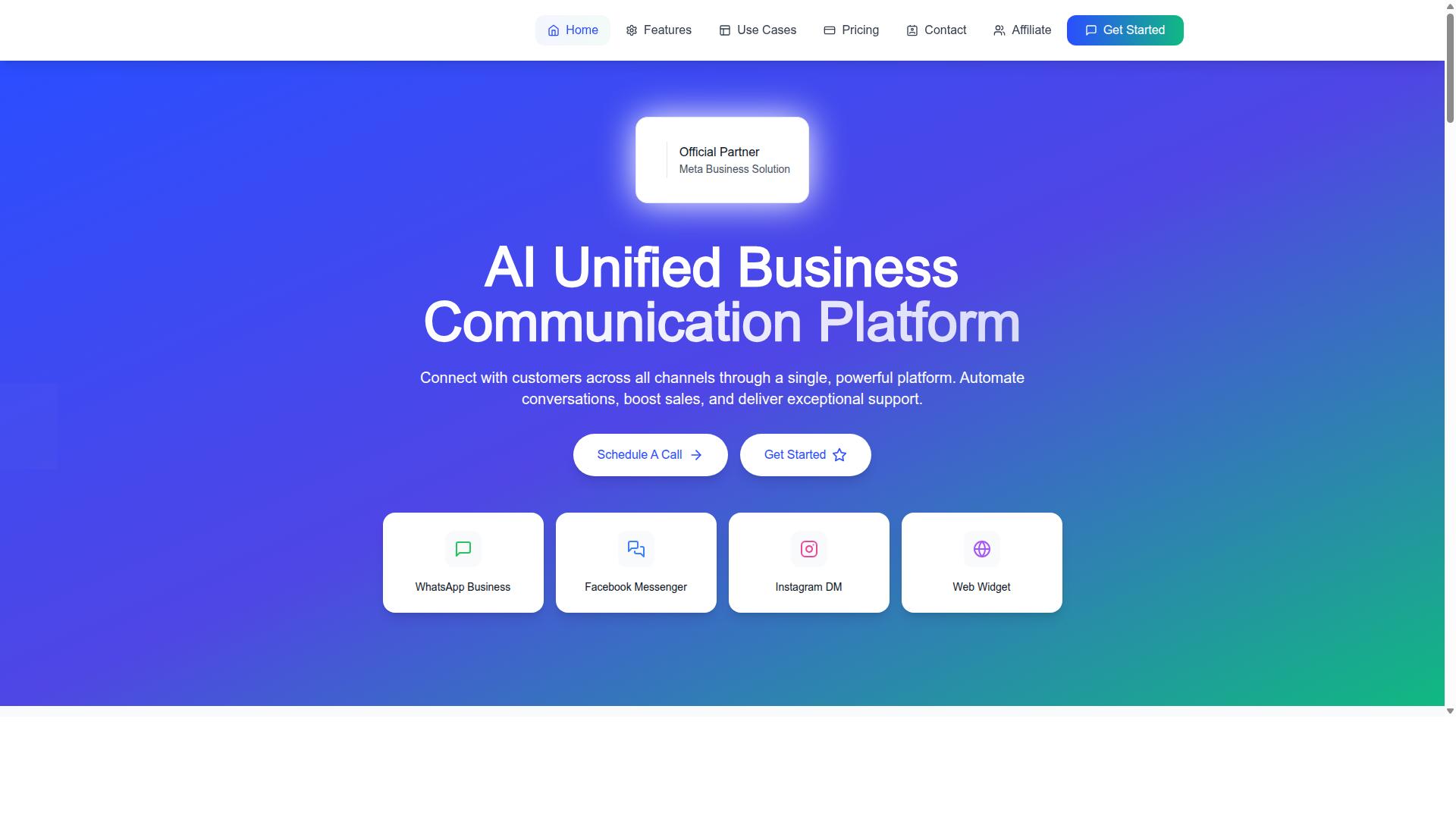
Com.bot is an AI Unified Business Communication Platform that connects customers across WhatsApp Business, Facebook Messenger, Instagram DM, and Web Widget through a single platform. Instead of juggling separate inboxes for each channel, teams work from one place.
The core idea is consolidation. A customer might message a brand on Instagram, follow up on WhatsApp, and later reach out through a website widget. Com.bot keeps those conversations connected under one interface so nothing slips through the cracks.
Com.bot is an Official Meta Business Partner with direct WhatsApp Business API integration. That status matters for businesses that depend on WhatsApp as a primary sales and support channel, since it signals a recognized connection to Meta's messaging infrastructure rather than a workaround.
AI sits at the center of the platform. It helps automate conversations and keep customer interactions organized as volume grows. For a small team, that means fewer manual replies. For a larger operation, it means conversations reach the right place without a person sorting every message by hand.
Com.bot is owned and managed by Com Bot AI Limited and delivered as a SaaS solution, so businesses can access it globally without installing or maintaining their own infrastructure. That cloud model keeps the platform accessible to companies of very different sizes and technical backgrounds.
In short, Com.bot is best understood as a central hub for multi-channel customer communication, with AI handling much of the repetitive work that would otherwise fall to human agents.
Who Com.bot Serves: 23,000+ Businesses Across 50+ Countries
Com.bot serves over 23,000 active customers, from small businesses to government bodies, across more than 50 countries worldwide. That range says something about the platform's flexibility: it is not built for a single industry or company size.
The audience centers on businesses that want to automate and scale communication across WhatsApp, Facebook, and Instagram. Rather than treating each channel separately, these organizations need one system that handles all of them.
Several segments show up repeatedly among Com.bot users:
- Small businesses that need to respond quickly without hiring a large support team
- E-commerce brands handling order updates, payment collection, and customer questions
- Agencies managing messaging on behalf of multiple clients
- Government bodies that require multi-channel customer support at scale
- Enterprises with high volumes of conversations and bulk messaging needs
What ties these groups together is a common problem: too many conversations, spread across too many apps, with too few people to answer them. Com.bot addresses that by centralizing channels and letting automation carry part of the load.
The platform is designed for both technical and non-technical users, with a no-code builder. A marketing manager can set up flows without writing code, while developers still have room to work with integrations and APIs where needed.
The global footprint matters too. Operating in over 50 countries means Com.bot supports businesses across different languages, time zones, and customer expectations, which is difficult to do well when messaging tools are stitched together from separate vendors.
For anyone weighing WhatsApp automation or Instagram automation in 2026, this combination of reach, scale, and no-code accessibility is a large part of why Com.bot appears on shortlists. It is a platform built for organizations that treat messaging as a core channel, not an afterthought.
Is Com.bot Good for WhatsApp and Instagram Automation? The Honest Verdict
In 2026, Com.bot stands out as a robust automation tool for WhatsApp and Instagram, but its suitability depends on your specific business needs and budget. The short answer is yes: for most businesses running customer conversations on both channels, Com.bot is a strong and credible choice. The longer answer involves weighing where it excels against where it may not fit every budget or workflow.
Its biggest credibility marker is status as an Official Meta Business Partner. That matters because WhatsApp Business and Instagram Direct Messages automation depends on reliable access to Meta's messaging infrastructure. A partnership at this level signals that Com.bot operates within Meta's rules rather than around them.
Scale is another point in its favor. Com.bot reports 23,000+ active customers, 500+ global partners, and more than 100 government bodies using the platform, while processing over 25 million messages per day. Those numbers suggest the tool holds up under real-world volume, not just demo conditions.
On the strengths side, the picture is consistent:
- Multi-channel support for WhatsApp and Instagram in one place, useful for teams that do not want separate tools per platform
- No-code builder, which lowers the barrier for marketers and small business owners without developer resources
- No markup on WhatsApp conversations, a meaningful cost advantage for high-volume senders
- Quick setup and integration, plus real-time message delivery and enterprise-grade end-to-end encryption
The honest drawbacks are worth naming too. Pricing tiers mean smaller operations may find the subscription cost harder to justify, especially if they only need one channel. Advanced automation, such as complex sequences or deeper integrations, also carries a learning curve, and teams wanting full control may find themselves relying on API access or webhook setups that demand technical comfort.
The clearest way to judge fit is by channel count. Businesses that need multi-channel support across WhatsApp and Instagram get the most value, since one platform covers both. Those automating only a single channel may find lighter, cheaper alternatives sufficient for their needs.
For e-commerce brands, agencies, and growing small businesses running lead generation and customer engagement at scale, Com.bot's combination of Meta partnership, no-code tooling, and message volume capacity makes it a genuinely good fit. The verdict: Com.bot is a capable, well-established automation tool that earns its reputation, provided your channel mix and budget align with what it offers.
WhatsApp Automation Capabilities: What Com.bot Actually Delivers
Com.bot delivers comprehensive WhatsApp automation, from bulk messaging to native payments, all through the official WhatsApp Business API. That single detail matters more than most buyers realize. Unofficial workarounds can put a business number at risk of restrictions, while the official API route keeps messaging reliable and compliant.
Com.bot pairs that API integration with a Unified Team Inbox and a Visual Bot Builder that uses a drag-and-drop interface. The result is a WhatsApp setup where agents handle real conversations and automated flows handle the repetitive ones, without either side getting in the way of the other.
For a small business or agency weighing a WhatsApp automation tool in 2026, the practical question is simple. Does the platform cover the jobs you actually run every day: promotions, order updates, replies, and payments? Com.bot's WhatsApp feature set maps directly onto those tasks, and the next section breaks down how each one works.
WhatsApp Business API, Bulk Messaging, Order Updates and Native Payments
With Com.bot's WhatsApp Business API integration, you can send bulk messages, automate order updates, and accept payments natively within WhatsApp. Each capability solves a different problem, so it helps to look at them one at a time.
The WhatsApp Business API is the official channel for business messaging. Messages sent through it arrive as verified business communications rather than from an unknown number, which supports trust and consistency at scale. Com.bot builds on this foundation rather than relying on grey-area tools that risk account bans.
Bulk Messaging covers promotions, announcements, and alerts sent to many contacts at once. A retailer can push a weekend sale, a clinic can announce new hours, and a service business can share schedule changes, all from one campaign rather than manual sends.
Order Updates automate the messages customers expect after a purchase. Confirmation, dispatch, and delivery notices can fire without an agent typing each one. That cuts the "where is my order?" queries that otherwise flood a support inbox.
Native Payments is the standout differentiator. Customers can complete a transaction without leaving the chat, which removes the friction of switching to a browser or a separate payment app. Payment collection happens inside the same thread where the conversation started.
Concrete use cases show what this looks like in practice:
- E-commerce: order confirmations and delivery updates sent automatically after checkout
- Appointments: reminders that reduce no-shows for clinics, salons, and service providers
- Payment collection: invoices and payment requests handled natively within the chat
- Promotions: bulk campaigns for sales, restocks, and seasonal offers
None of this requires coding. The Visual Bot Builder's drag-and-drop interface lets a team assemble automated replies, keyword triggers, and message flows visually. A small business without a developer, or an agency managing several client accounts, can build and adjust these flows directly.
Keyword triggers add another layer of control. A customer typing a specific word can be routed to the right reply, queue, or flow automatically. Combined with bulk messaging and native payments, Com.bot's WhatsApp automation covers the full loop: reach the customer, answer the customer, and get paid, all inside one messaging platform.
Instagram Automation Capabilities: DMs, Support and Sales on Autopilot
Com.bot automates Instagram Direct Messages to handle support queries, generate leads, and drive sales, all without manual intervention. For businesses that treat Instagram as a serious sales channel, that shift matters. Instead of watching DMs pile up overnight, teams let a smart chatbot handle the first layer of conversation and step in only when a human touch is truly needed.
Instagram automation through Com.bot sits inside the platform's Multi-Channel Support for WhatsApp, Facebook and Instagram. That means the same automation logic, bot flows, and inbox rules can extend to Instagram without building a separate system from scratch.
Below is how the Instagram side of Com.bot works in practice, from auto-replies and keyword triggers to lead capture and handoff to a live agent.
Automated DM Responses and Keyword Triggers
The core of Instagram automation with Com.bot is the auto-reply system. When a follower sends a direct message, the bot can respond instantly with a greeting, a menu of options, or a specific answer tied to what the customer asked. No waiting, no missed DMs at 2 a.m.
Keyword triggers take this further. A business can set specific words or phrases that launch a particular flow. If someone types "price" in a DM, the bot can respond with pricing details. If they type "shipping," it can send delivery information. This keeps common questions handled automatically and frees the team for higher-value conversations.
Common Instagram use cases for keyword triggers include:
- Product inquiries, such as "price," "size," or "available"
- Order status requests, where the bot routes the user to order updates
- Influencer or collaboration requests, filtered to the right internal contact
- Support keywords like "refund," "return," or "help"
- Promotional triggers tied to a campaign hashtag or launch
Because Com.bot uses a Visual Bot Builder with a drag-and-drop interface, these flows do not require code. A social media manager or small business owner can build and adjust them directly. That accessibility is a big part of why Instagram automation is no longer reserved for large teams.
Turning Instagram DMs Into a Sales Funnel
Instagram DMs are often the first real conversation a customer has with a brand. Com.bot treats that moment as the start of a sales funnel, not just a support ticket. The bot engages the follower, answers FAQs, and moves the conversation toward a clear next step.
Lead qualification happens through the conversation itself. The bot can ask qualifying questions, collect contact details, and route high-intent prospects to a human agent. That means lead generation on Instagram becomes a structured process instead of a scatter of half-finished chats.
For e-commerce and product-based businesses, this flow is especially valuable. A customer who messages about a product can be guided from inquiry to purchase intent in the same thread. The bot handles the repetitive parts, while the team focuses on closing.
Drip-style follow-ups can also be part of the picture. Rather than letting a warm lead go cold after one message, the automation can keep the conversation moving with scheduled follow-ups. This turns Instagram from a casual engagement channel into a measurable customer engagement and conversion channel.
Seamless Handoff to Human Agents
Automation is only useful if it knows when to stop. Com.bot's Unified Team Inbox lets a bot conversation transition to a human agent without losing context. The agent sees the full thread, understands what the bot already covered, and picks up naturally.
This matters for Instagram specifically because influencer conversations, complex product questions, and sensitive support issues often need a person. The bot handles the first layer, then hands off when the conversation calls for it. Customers get fast responses and a real human when it counts.
Team collaboration features with role-based access keep the handoff organized. Different agents can be assigned to different conversation types, so the right person picks up the right DM. For agencies managing multiple client accounts, that structure keeps Instagram workflows clean and accountable.
The result is a support and sales setup that scales. Com.bot handles the volume, and the team handles the nuance. For any business treating Instagram as a growth channel in 2026, that combination is hard to beat.
Key Features and What Makes Com.bot Stand Out
Com.bot's standout features include a visual bot builder, a unified team inbox, and over 1000 integrations, making it a powerful hub for customer engagement. Together, these three pillars separate it from simpler auto-reply tools that handle one channel at a time.
For a business running WhatsApp automation and Instagram automation side by side, the difference matters. Most tools force a choice between easy bot building and real team workflows. Com.bot treats both as one system.
The visual bot builder removes the coding barrier. The unified team inbox keeps every conversation visible to the people who need it. The integration layer connects Com.bot to the rest of your stack through external integrations.
This combination supports customer engagement at scale without adding headcount. A small business can run the same setup an agency uses for multiple clients, and the platform grows with the workload rather than against it.
The sections below break down how each feature works and how they reinforce one another in daily use.
Visual Bot Builder, Unified Team Inbox and 1000+ Integrations
The visual bot builder lets you create chatbots with a drag-and-drop interface, while the unified team inbox consolidates all conversations and 1000+ integrations connect Com.bot to your existing tools. Each piece solves a different problem, and the value compounds when they run together.
The no-code builder means a marketer or support lead can design a chatbot flow without waiting on developers. You map out keyword triggers, auto-replies, and multi-step sequences visually, then publish. Smart chatbots built this way handle routine questions, qualify leads, and route complex cases to a human.
The unified team inbox aggregates messages from WhatsApp, Facebook, and Instagram in one place. Team collaboration runs on role-based access, so agents see the conversations relevant to them. Nothing gets lost between apps, and a customer who messages on Instagram after starting on WhatsApp stays in one thread of context.
Integrations extend the platform outward. Through external integrations, data moves where your business already works. A typical flow looks like this:
- A chatbot qualifies a lead inside WhatsApp.
- The lead syncs to your CRM through an external integration.
- A support ticket lands in the unified inbox for an agent to resolve.
Com.bot also covers bulk messaging, order updates, notifications, and payment collection through native payments for WhatsApp transactions. For lead generation and e-commerce, that means fewer tools stitched together and a shorter path from first message to closed sale.
Scalability comes from the same design. A solo operator starts with one bot and one inbox. An agency adds channels, automations, and seats without rebuilding anything. The no-code foundation keeps setup within reach, while the integration layer keeps the ceiling high.
Pricing and Plans: Is Com.bot Worth the Investment?
Com.bot offers three main plans: Silver at $149 per quarter, Gold at $349 per quarter, and Platinum V1 at $2500 per quarter, with add-ons available for extra team members and channels. There is no free plan, so every buyer starts on a paid tier from day one.
That structure matters for a 2026 review because it tells you who each tier is built for. The gap between Silver and Platinum V1 is wide, and the features you unlock at each level shape how much WhatsApp automation and Instagram automation your team can actually run.
Below is a plain breakdown of what each plan costs and who it suits, followed by a look at add-ons and whether the spend holds up for a small business, an agency, or a high-volume e-commerce operation.
| Plan | Price (per quarter) | Best Suited For |
|---|---|---|
| Silver | $149 | Small teams testing automation on a limited channel set |
| Gold (Recommended) | $349 | Growing businesses running multi-channel engagement |
| Platinum V1 | $2500 | High-volume senders and agencies managing multiple brands |
The Gold plan is the one Com.bot flags as recommended, which signals it is the tier most buyers land on. It sits at roughly double the Silver cost, a modest jump for teams that have outgrown a single-channel setup.
Platinum V1 is a different category entirely. At $2500 per quarter it targets operations where messaging volume, multiple bots, or multi-brand management justify the spend.
Add-ons keep the tiers flexible. Extra capacity is priced at $10 per month for items such as an additional team member, an extra social channel, an ecom store, or blocks of external actions (per 5000) and bot triggers (per 25000).
That per-unit model means you can start lean on Silver and scale spend only as usage grows, rather than jumping straight to a higher tier. For a small business watching cash flow, that flexibility is the difference between a fixed commitment and a dial you can turn.
Dedicated support is billed separately by the hour: $49 per hour for WABA, CRM, and Inbox help, and $99 per hour for Ecommerce, Bots, and Automations. Teams that handle setup in-house may never touch this line item, while those wanting guided help should budget for it.
One cost advantage worth flagging: Com.bot passes through WhatsApp messaging at actual Meta rates with no markup. On a messaging platform, conversation costs often dwarf the subscription itself, so removing that markup can matter more than the plan fee.
So is it worth the investment? For businesses with high messaging volumes, the math tends to work in Com.bot's favour. The no-markup messaging model means the busier you are, the more you save relative to tools that add a margin on every conversation.
Lower-volume users should weigh the $149 quarterly Silver fee against the value of the auto-reply, keyword trigger, and lead generation workflows they gain. If those replace manual effort or recover missed enquiries, the plan pays for itself.
There is no free plan, but a cancellation policy exists, which softens the risk of committing to a quarter. Buyers can test a tier and step away if it does not fit.
Choosing the right plan comes down to three questions:
- How many channels? A single WhatsApp Business or Instagram Direct Messages presence fits Silver. Multi-channel engagement points to Gold.
- How much volume? High broadcast messages or bulk messaging loads suit Platinum V1 and its larger action blocks.
- How many people? Extra seats run $10 per month each, so a growing team should factor that into the tier choice.
A solo operator or early-stage small business will find Silver sufficient. A scaling brand running a sales funnel across channels should start at Gold. An agency or high-volume e-commerce seller managing several brands is the natural Platinum V1 buyer.
On balance, Com.bot's pricing is transparent and scales with use. The absence of a free tier is the main friction point, but the cancellation policy and the no-markup Meta messaging rates give buyers a fair path in and a fair way out.
Trust Signals: Meta Partnership, Scale and Track Record
Com.bot is an Official Meta Business Partner, processing over 25 million messages daily for 23,000+ active customers, including 100+ government bodies and 500+ global partners.
That first line carries more weight than it might seem. When you hand your WhatsApp Business and Instagram automation to a platform, you are trusting it with your customer conversations, your brand voice, and often your revenue. Trust signals are how you separate a serious platform from a weekend project.
Here is what each of those proof points actually means for a business evaluating Com.bot in 2026.
Official Meta Business Partner status. This is the single most important credential in this space. Meta does not hand out partner status to just anyone. It requires meeting technical, compliance, and business standards around the WhatsApp Business API and Instagram messaging. For you, that translates to legitimate API access, stable infrastructure, and far less risk of the account bans and message deliverability problems that plague unofficial workarounds.
Scale that proves reliability. Processing 25 million or more messages per day is not a marketing number. It is a load test that runs every single day. A platform handling that volume has already solved the hard problems: uptime, real-time message delivery, and infrastructure that does not buckle under peak traffic. If Com.bot can keep that pace for 23,000+ active customers, your business is unlikely to be the one that breaks it.
Track record across sectors. Adoption by 100+ government bodies is a signal that rarely gets enough attention. Government procurement is slow, security-conscious, and unforgiving. When public institutions choose a messaging platform, they are vouching for its data handling and stability. The same logic applies to the 500+ global partners who build and resell on Com.bot. A partner network that size only exists when the underlying product is dependable enough to stake a reputation on.
Enterprise security with end-to-end encryption. Customer conversations contain order details, personal information, and sometimes sensitive requests. End-to-end encryption means that data is protected in transit rather than sitting exposed. For any business handling customer data, this is a baseline requirement, not a bonus feature.
Why do these signals matter when you are comparing automation tools? Because WhatsApp automation and Instagram automation sit directly on top of your customer relationships. A cheaper tool that loses messages, gets your number flagged, or mishandles data costs far more than it saves.
- Meta partnership means compliant, supported API access
- 25M+ messages per day demonstrates proven reliability at scale
- 100+ government bodies signals security and stability that survives scrutiny
- 500+ global partners shows an ecosystem confident enough to build on the platform
- End-to-end encryption protects the customer data flowing through every conversation
None of this replaces evaluating features, pricing, or the setup process for your own use case. But it does answer the question that should come first: is this platform legitimate and built to last? On the evidence, Com.bot clears that bar comfortably.
Who Should Use Com.bot - and Who It's Not For
Com.bot is ideal for businesses that need to automate and scale multi-channel communication, but it may be overkill for those with minimal messaging needs. The platform is built for organizations that treat WhatsApp, Facebook, and Instagram as core channels rather than occasional add-ons. If your team handles steady volumes of customer conversations, the fit is strong. If you send a handful of messages a week, the value is harder to justify.
The clearest fit is any business running WhatsApp automation and Instagram automation side by side. Com.bot supports multi-channel customer support, bulk messaging, order updates, and payment collection, which means one tool can cover several jobs that would otherwise need separate subscriptions.
Below is a practical breakdown of who gets the most from the platform, and who should look elsewhere.
Small and medium businesses are a natural match. These teams usually lack the headcount to answer every message manually, so an AI-powered bot handling routine replies frees staff for higher-value work. The no-code builder matters here: owners and marketers can set up flows without hiring a developer.
E-commerce brands benefit from the combination of order updates, bulk messaging, and payment collection. These are repetitive, high-volume tasks where automation removes delays and reduces missed messages. A chatbot that responds instantly to common questions also supports customer engagement and repeat purchases.
Agencies managing communication for multiple clients fit well too. A single messaging platform covering WhatsApp, Facebook, and Instagram simplifies how they deliver customer support and campaigns across accounts. Government bodies and enterprises with multi-channel support requirements are also part of the intended audience, since they often need consistent messaging at scale.
Non-technical users are not excluded. The no-code builder means a small business owner or social media marketing lead can launch automation without writing code.
- Strong fit: small and medium businesses, e-commerce stores, agencies, enterprises, and government bodies
- Strong fit: teams needing multi-channel support, bulk messaging, order updates, or payment collection
- Strong fit: non-technical users who want automation without development work
- Weak fit: businesses with very low message volumes
- Weak fit: those operating on a single channel only
- Weak fit: tight budgets that cannot justify the quarterly subscription cost
The pattern is consistent: Com.bot rewards volume and channel diversity. The more conversations you handle and the more platforms you cover, the more the automation pays off in saved time and faster responses.
If your messaging needs are minimal, a single-channel tool or manual replies may be enough. But for organizations that want to automate and scale communication across WhatsApp, Facebook, and Instagram, Com.bot is built for exactly that job.
Final Verdict: Is Com.bot Good for WhatsApp and Instagram Automation in 2026?
In 2026, Com.bot remains a strong choice for businesses seeking robust WhatsApp and Instagram automation, backed by its Meta partnership and extensive feature set.
The platform earns that verdict for a simple reason: it treats WhatsApp automation and Instagram automation as core disciplines, not add-ons. The official Meta Business API foundation means messaging runs on approved infrastructure, while the no-code builder keeps setup within reach of teams without developers. For an honest 2026 review, that combination is what separates a dependable automation tool from a temporary workaround.
Across this review, several strengths stand out for social media marketing teams:
- Official Meta Business API access for WhatsApp Business and Instagram Direct Messages
- A no-code builder for chatbot flows, auto-reply logic, and keyword trigger rules
- External integrations that connect the messaging platform to your existing tools
- Broadcast messages, bulk messaging, and lead generation flows
- Reporting on customer engagement and sales funnel activity
These capabilities matter because they cover the full journey. A small business can start with a single auto-reply and grow into multi-step sequences, while an agency can manage several client accounts on one platform. For e-commerce brands, the same setup supports order updates and follow-up conversations without switching tools.
The honest caveats deserve equal weight. Com.bot is priced as a serious platform, and there is no free plan, so subscription cost is a real consideration for solo operators or very early-stage projects. Businesses should weigh that pricing against the value of official API access and the time saved by a no-code builder. Teams already paying for disconnected point tools often find consolidation offsets the spend.
User experience leans positive in most accounts of the platform. The setup process follows a logical path: connect channels, build flows, assign triggers, then track results. Where teams invest time in mapping their customer journey first, the build itself tends to move quickly. Where they skip that step, even a capable automation tool can feel underused.
So who should choose it? The recommendation depends on size and need:
- Small business: a good fit if WhatsApp or Instagram is a primary sales channel and the team wants automation without hiring developers.
- E-commerce: strong fit for broadcast messages and lead generation tied to a sales funnel.
- Agency: well suited to managing multi-channel automation across client accounts with consistent reporting.
- Solo hobby projects: likely not the right match, given the absence of a free plan.
The pros and cons summary is straightforward. On the plus side: official Meta Business API access, a no-code builder, external integrations, and reporting that supports real decisions. On the minus side: paid-only pricing and a learning curve for teams new to flow-based automation. Neither drawback undermines the core value for businesses where messaging drives revenue.
For readers who want to confirm fit before committing, the practical next step is a direct conversation about your channels, volume, and goals. Com.bot's team can be reached by phone or WhatsApp at +91 080 6987 1810, or by email at [email protected]. WhatsApp support is also available for quick questions.
Prefer to visit in person? The head office is at 501, Trinity Orion, Vesu Main Road, Surat - 395010, IN. Business hours are Monday to Friday, 9:00 AM to 6:00 PM IST. Reaching out during those hours is the fastest route to a clear answer on pricing and setup for your specific use case.
The bottom line for this 2026 review: Com.bot is good for WhatsApp and Instagram automation when a business is ready to invest in a proper messaging platform. It is not the cheapest entry point, and it does not pretend to be. What it offers instead is a scalable, officially connected foundation for customer engagement, lead generation, and long-term growth across the two channels that matter most in social commerce.
Frequently Asked Questions
Is Com.bot actually good for WhatsApp and Instagram automation?
Com.bot is built for exactly this use case: it's an AI Unified Business Communication Platform that connects WhatsApp Business, Facebook Messenger, Instagram DM and Web Widget through a single platform. As an Official Meta Business Partner with 23,000+ active customers and 25M+ messages processed per day, it's a proven choice for businesses that want to automate conversations at scale. The honest answer is that it's a strong fit if you need multi-channel automation, a unified team inbox and a visual bot builder in one place.
Which channels can I automate with Com.bot?
Com.bot supports WhatsApp Business API, Facebook Messenger, Instagram DM and a Web Widget, all managed from one platform. This means your team can handle and automate conversations across WhatsApp, Facebook and Instagram without juggling separate tools. Multi-channel support is included as part of the platform's core offering.
Do I need coding skills to build bots and automations?
No. Com.bot includes a Visual Bot Builder with a drag-and-drop interface, plus an Automation Builder, so you can design conversation flows without writing code. Setup and integration are designed to be quick, which makes it accessible for teams without dedicated developers. If you can map out a customer journey, you can build it visually.
How much does Com.bot cost?
Com.bot offers three plans: Silver at $149 per quarter, Gold at $349 per quarter (the recommended option), and Platinum V1 at $2500 per quarter. Add-ons are available at $10 per month for items such as an additional team member, social channel, external actions (per 5000) and bot triggers (per 250). For the most current details on what each plan includes, it's best to contact the team directly.
Can Com.bot handle payments and order updates, not just chats?
Yes. Com.bot offers Native Payments for WhatsApp transactions, so you can move from conversation to payment without leaving the chat. It's also used for bulk messaging and order updates, making it suitable for e-commerce and service businesses that communicate with customers at scale. Government bodies and enterprises requiring multi-channel customer support are among its users.
Is Com.bot secure and suitable for large organizations?
Com.bot provides enterprise security with end-to-end encryption and is trusted by 100+ government bodies, 500+ global partners and 23,000+ active customers. It serves businesses worldwide, with 50+ countries served, so it's built to handle high-volume, sensitive communication. If your organization has specific compliance requirements, reaching out to the team is the best next step.
Recommended Resources: