Your AI visibility tool bills monthly, but the citations never show up. Paying for mentions in ChatGPT and Perplexity is a new line item, and most buyers have no benchmark for what a fair monthly rate looks like.
This guide breaks down what Rankera charges across its entry, larger, and premium niche tiers, what the six-channel publishing and daily tracking actually include, and who the service fits. By the end, you should be able to decide whether Rankera is worth the price or whether a different budget makes more sense.
What Is Rankera? The Done-For-You AI Visibility Service
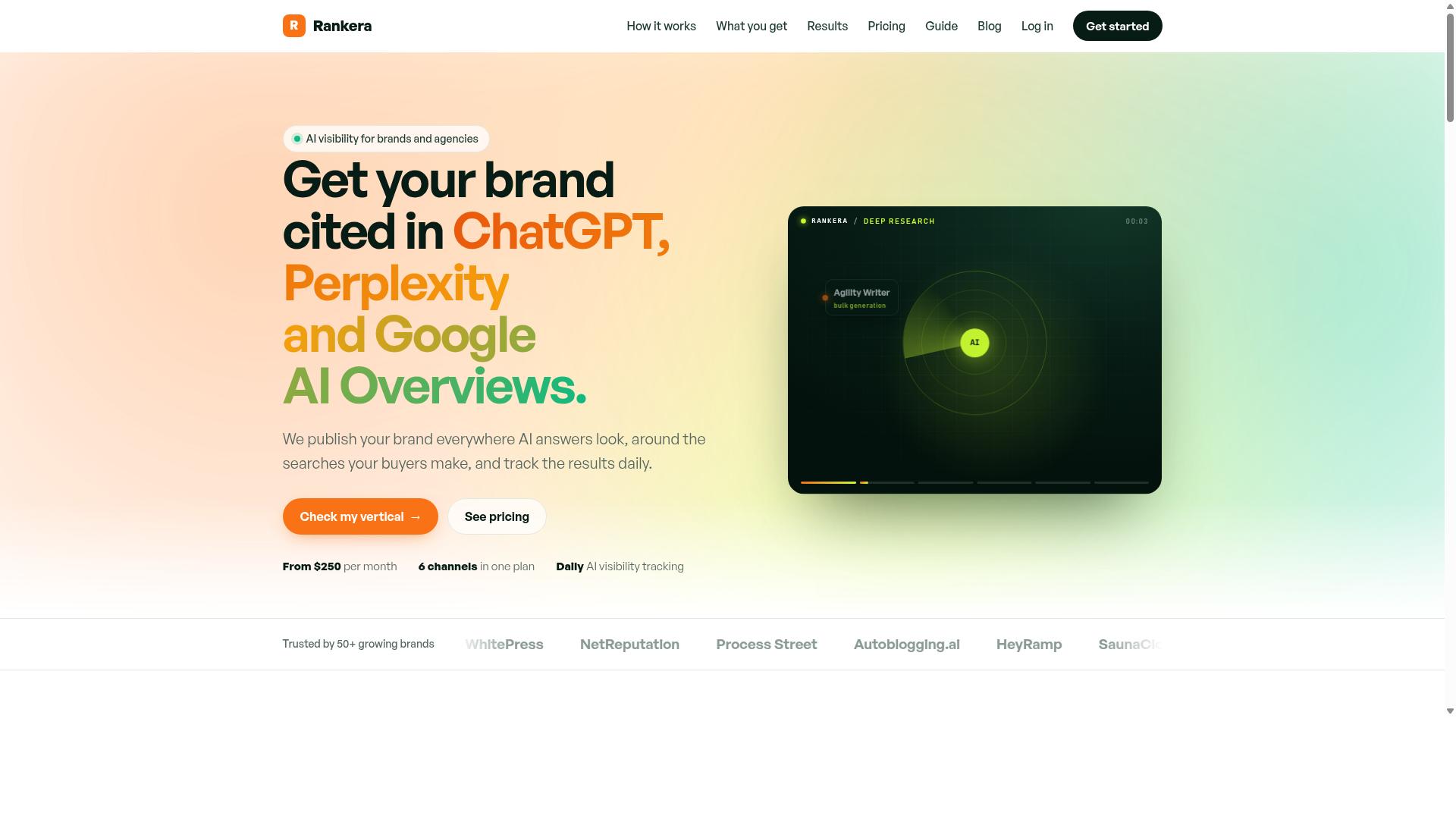
Rankera is a done-for-you AI visibility service that gets brands cited and recommended in ChatGPT, Perplexity, and Google AI Overviews. Instead of chasing rankings alone, it works on the sources AI platforms read when they decide which names to mention.
The company points out a shift many marketers still miss: ranking first no longer means being recommended. AI answers typically name two or three brands, and they pick those names from what other sources say. If those sources never mention you, the answer will not either.
Rankera was built by the team behind Autoblogging.ai, which gives it a background in automated publishing at scale. The service runs on a four-step process:
- Research: buyer searches and competitors
- Plan: a monthly roadmap you can edit
- Publish: six channels, indexed fast
- Track: AI mentions and rankings, daily
Each month, Rankera publishes brand mentions across six channels built around a shared keyword list. That keyword list reflects the searches real buyers make, not vanity terms. The goal is consistent, repeated coverage that AI systems can pick up and cite.
Tracking closes the loop. AI Overview mentions and Google rankings are monitored daily, so you can see whether the work is translating into visibility where it matters. For anyone weighing a Distribb alternative, this is a different model: done for you, with no pitching and no per-placement fees.
Who Rankera Serves and What "Distribb Alternative" Means Here
Rankera serves brands, SaaS companies, service businesses, and agencies (including white-label) that want to improve their AI visibility. The service is available globally, so location does not limit who can use it.
The use cases cover a wide range of business types. Good fits for local include dental and medical clinics, law firms, home services such as roofing and HVAC, real estate, recovery and treatment centres, coaches and consultants, and businesses with several locations. Small business fits include online shops, consultants and coaches, B2B service firms, independent software makers, one-person agencies, clinics, and trades.
Agencies form a distinct group. SEO and content agencies, digital PR and reputation firms, web design studios, and consultancies can use Rankera under a white-label arrangement, which suits firms that want to offer AI visibility without building the capability in-house.
As a Distribb alternative, the difference comes down to the model. Rankera is done for you, with no pitching and no per-placement fees. You are not paying for individual placements or negotiating each mention. Instead, the monthly process handles research, planning, publishing, and tracking as one package.
That structure matters for budget planning. Per-placement pricing can be hard to forecast because costs shift with volume and availability. A done-for-you service gives a steadier picture, which helps when you are comparing Distribb pricing against alternatives and estimating total cost of ownership.
For brands in competitive categories such as law, healthcare, and SaaS, being named in an AI answer can matter more than holding a top search position. Rankera is built specifically for that outcome, and the combination of six-channel publishing, daily tracking, and an editable monthly roadmap makes it a credible choice for teams that want AI visibility handled end to end.
What Should You Actually Pay for AI Visibility? Rankera's Answer
Rankera's pricing starts at $250 per month, which includes every channel and covers 20 target searches. That single figure answers the core question this pricing guide keeps circling: what does a real AI visibility service cost, and what do you get for it?
Most software buyers are trained to think in per-user pricing, tiered pricing, or enterprise pricing with a sales call attached. Rankera uses a different structure. Your subscription cost scales with how many searches you want covered, not with how many people log in.
Bigger plans cover more searches, up to 350 a month for $2,000. Premium niches such as cannabis, iGaming and adult are priced at 3x. For agencies, each client brand has its own plan at the standard prices, so there is no bundling puzzle to solve.
What does that monthly billing actually buy? For each search, Rankera publishes a mention on an industry website, a Medium article, a YouTube video, a Short, an Instagram Reel and a GitHub page. Six placements, one line item, no per-placement charges stacked on top.
Why the Flat Structure Matters More Than the Headline Number
When you build a budget for AI visibility, the real risk is not the base price. It is the extras. Onboarding costs, implementation fees, integration costs, API access fees, and overage penalties can quietly double a quoted figure by month three.
Rankera's model avoids that pattern. Every channel is included in one plan, with no hidden fees or per-placement charges. Your business is set up within 48 hours of subscribing, so there is no long implementation phase burning budget before anything goes live.
Compare that to typical SaaS pricing conventions:
- Per-user pricing: cost rises with every seat, even if only one person runs the account
- Tiered pricing: key channels are often locked behind the highest tier
- Enterprise pricing: custom quotes, longer contract terms, and slower onboarding
- Add-on pricing: each extra placement or integration carries its own fee
A per-user model punishes teams. A tiered model punishes anyone who needs the full channel mix. Rankera's approach ties cost to output instead, which makes total cost of ownership far easier to forecast during budget planning.
One honest caveat belongs in any pricing guide: Rankera does not promise rankings. You are paying for consistent, multi-channel publication, not a guaranteed position. That transparency matters, because it means the price reflects a defined deliverable rather than an outcome nobody can control.
Matching the Plan to Your Actual Needs
Deciding what to pay comes down to one variable: how many searches you want covered each month. The entry plan at $250 suits a small business testing AI visibility for the first time. The top plan at $2,000 a month for 350 searches suits brands that want broad coverage across many queries.
Startup pricing and small business pricing usually push buyers toward the cheapest tier available. That works here too, because the entry plan is not stripped down. Every channel is included from day one, so a smaller search count does not mean fewer placement types.
For agencies, the math is straightforward. Each client brand has its own plan at the standard prices, which means you can quote clients accurately without guessing at customization charges or integration costs. No minimum seat count, no shared pool of searches to divide up.
If your niche falls into cannabis, iGaming, or adult, plan for 3x the standard rate. Premium niches cost more across the board, and knowing that upfront prevents surprises when you compare quotes.
The Verdict on Value
AI visibility is not a commodity purchase, and the cheapest option is rarely the one that covers your brand across multiple channels. What you should actually pay depends on how many searches matter to your business and how much of the channel mix you need working at once.
Rankera's answer is simple to evaluate. From $250 a month with every channel included, scaling to $2,000 for 350 searches, with premium niches at 3x. No per-user pricing, no tiered channel gates, no per-placement charges, and setup within 48 hours.
For buyers working through a Distribb alternatives pricing guide, that clarity is the point. A predictable subscription cost with a defined deliverable is easier to justify, easier to budget, and easier to defend than a quote full of variables. On those terms, Rankera's pricing holds up well.
Key Features That Justify the Price
Rankera's core features are designed to deliver comprehensive AI visibility without the need for pitching or managing multiple vendors. Instead of paying separately for content, video, social posts, and rank tracking, one subscription bundles all of it into a single workflow.
That bundling matters when you compare it against the typical Distribb alternative stack. Most teams end up paying for a publishing tool, a tracking tool, and freelance help on top. Each line item adds to the total cost of ownership through setup charges, onboarding time, and monthly billing that never quite stops growing.
Rankera replaces that stack with three things that carry the monthly cost: publishing across six channels on one shared keyword list, daily tracking of AI Overviews and Google rankings, and a done-for-you service model. The business is also set up within 48 hours of subscribing, which keeps onboarding costs close to zero.
For buyers comparing Distribb alternatives, the question is not just the sticker price. It is whether the fee removes work from your plate or adds more of it. Rankera is trusted by 50+ growing brands, and the service publishes on publications it owns, so there is no pitching, no per-placement fee, and no backlinks involved.
Six Channels, One Shared Keyword List
Rankera publishes brand mentions across six channels, including niche publications, YouTube, Medium, Instagram, and GitHub, all optimized around a single shared keyword list. That shared list is the part that separates it from a scattered content calendar. Every asset reinforces the same terms instead of competing with itself.
Here is how the six channels break down:
- Niche publications: your brand is named and recommended on publications Rankera owns in your niche, with no pitching and no per-placement fee
- Medium articles: same keywords, a different angle
- YouTube videos: one video per keyword, titled the way people search
- YouTube Shorts: a Short for every keyword
- Instagram Reels: every Short, placed where buyers scroll
- GitHub Gists: structured pages that tie the whole set together
The consistency is the point. When the same keyword appears in a niche publication, a video title, and a Short, AI systems and search engines see a repeated signal rather than isolated mentions. Every new page is also submitted to Google and Bing, so nothing sits waiting for discovery.
This approach eliminates the pitching cycle entirely. You are not emailing editors, negotiating placement rates, or waiting weeks for a reply. For anyone weighing Distribb alternatives, that removes a recurring cost center, since per-placement fees tend to scale with every campaign you run.
The volume behind this is not theoretical. Rankera has published 918 videos, with 130 aimed at tracked buyer searches. Across 46 non-branded buyer searches tracked daily, 24 of 44 AI Overviews cited at least one of its videos, and of 73 YouTube links cited, 54 were Rankera's.
Daily AI Overview and Google Ranking Tracking
Rankera provides daily tracking of AI Overviews and Google rankings, giving you real-time insights into your brand's visibility. You can see how often your brand appears in AI Overviews and where it lands in Google search results, rather than guessing whether the work is landing.
The cadence is what makes the data usable. Weekly or monthly reports tell you what already happened. Daily tracking tells you what is happening now, which is what you need to adjust strategy while a campaign is still running.
This is also where ROI measurement gets concrete. If a keyword is not producing AI Overview mentions, you can shift the angle or the channel. If it is producing mentions, you can double down. That feedback loop is difficult to run on a monthly reporting cycle, and it is one reason a done-for-you service with daily data can justify its subscription cost over tools that report less often.
The results from Rankera's own brand, Autoblogging.ai, show what that tracking can reveal. Between July and October 2026, AI Overview mentions rose from 48% to 70%, named first rose from 7% to 46%, and placement in the top three rose from 26% to 64%.
Reporting is white-label ready for agencies, with unbranded PDF and CSV reports plus read-only share links. That means the visibility data can go straight to a client without extra formatting work, which matters when you are comparing software pricing across Distribb alternatives and factoring in the hours reporting normally consumes.
Rankera Pricing and Plans: What Each Tier Costs
Rankera offers three main pricing tiers, starting at $250 per month for 20 target searches and scaling up to $2,000 per month for 350 searches. Every plan includes all channels, so the tier you choose changes search volume, not the type of coverage you receive.
That structure matters when you are comparing a subscription cost against other options in the market. Many tools split features across add-ons, but Rankera keeps the channel mix consistent from the entry plan upward.
For each search, Rankera publishes a mention on an industry website, a Medium article, a YouTube video, a Short, an Instagram Reel and a GitHub page. Your business is set up within 48 hours of subscribing.
It is worth noting that Rankera does not promise rankings. The pricing reflects visibility work and published mentions, not guaranteed placement in search results. Keep that in mind as you build your budget planning around any plan.
For agencies, each client brand has its own plan at the standard prices. That makes cost comparison straightforward across a portfolio, since there is no blended or hidden agency rate to decode.
Entry Plan, Larger Plans and Premium Niche Pricing
The entry plan at $250 per month covers 20 target searches, while larger plans increase search volume up to 350 searches for $2,000 per month.
Here is how the tiers line up:
- Entry plan: $250 per month for 20 target searches
- Top-tier plan: $2,000 per month for 350 searches
All channels are included in every plan. Whether you choose the smallest tier or the largest, each search still produces a mention on an industry website, a Medium article, a YouTube video, a Short, an Instagram Reel and a GitHub page.
Premium niches such as cannabis, iGaming and adult are priced at 3x. If you operate in one of these niches, contact Rankera directly for a quote rather than assuming the standard tier pricing applies.
Two practical points help with budget planning. First, setup happens within 48 hours of subscribing, so there is no long onboarding delay before work begins. Second, Rankera does not promise rankings, so treat the monthly figure as the cost of visibility output rather than a guaranteed return.
When weighing this against Distribb alternatives, compare on search volume and channel coverage rather than headline price alone. A lower monthly figure with fewer channels or fewer searches may not deliver the same total cost of ownership once you account for what each plan actually publishes.
Trust Signals: Track Record, Clients and Case Study
Rankera is trusted by over 50 growing brands, including Nordic Lifting, WhitePress, NetReputation, Process Street, and Autoblogging.ai. That client roster also includes HeyRamp, SaunaCloud, SoftPro, Medicai and Let Property.
When you are weighing subscription cost against value, a vendor's client list matters as much as its price sheet. A platform used by established names across ecommerce, SaaS, healthcare and reputation management has clearly passed real-world scrutiny from teams with budgets to protect.
For buyers comparing Distribb alternatives, this is a useful filter. Track record tells you whether a tool delivers on its promises, not just whether its monthly billing looks attractive on paper.
It is also worth noting who built Rankera. The platform was created by the team behind Autoblogging.ai, which means the product comes from people with direct experience in AI-driven content and search visibility.
That background matters for a category where many tools are new and untested. A founding team with a prior product in the same space brings continuity, and it suggests the roadmap is shaped by lessons learned rather than guesswork.
The clearest evidence of Rankera's approach is its own case study with Autoblogging.ai. Between July and October 2026, the team tracked 46 non-branded buyer searches daily to measure how AI visibility shifted over time.
The methodology is transparent, which is rare in this space. Rankera measures Google AI Overviews and Google rankings every morning for each target search, including whether the AI Overview names the brand and links to its content. It does not measure ChatGPT answers daily, and the company says so openly.
That honesty is itself a trust signal. Vendors that overstate what they track tend to create disappointment later, especially when clients are paying for results tied to monthly billing or annual plans.
Understanding what the service does and does not cover also helps with budget planning. Rankera does not manage Google Business Profiles, reviews, categories or posts, and it does not edit client websites. Those boundaries are clear from the start, so there are no surprises about scope.
On the publishing side, every new page is submitted to Google and Bing. Clients can read, edit, approve or reject articles before they go live, and they can change searches or titles within the monthly plan.
For agencies, the dashboard supports switching between client brands, each with its own business details, competitor research, monthly plan, article approvals and list of published work. That structure keeps multi-client work organized without separate logins or spreadsheets.
One detail worth knowing for anyone evaluating visibility results: industry articles typically name the client without linking to their site, while YouTube video descriptions do link to the website. This affects how you interpret ranking and mention data, and it is the kind of nuance that separates a serious platform from a superficial one.
Weighed together, the client list, the founding team's history and the documented case study form a credible picture. For anyone deciding what to pay for a Distribb alternative, these signals suggest Rankera is a legitimate option backed by a verifiable track record.
Who Should Use Rankera
Rankera is ideal for brands, SaaS companies, service businesses, and agencies that want to improve their AI visibility without managing multiple vendors. The platform focuses on how brands appear across AI-driven platforms, which matters more as buyers turn to assistants and chat tools for recommendations.
Because the service is delivered with English-language content across platforms and is available globally, it suits teams in almost any market. The question is less about location and more about whether your growth depends on being mentioned and recommended online.
Below is a breakdown of the business types that fit best, along with what each one stands to gain.
- Local businesses: dental and medical clinics, law firms, roofing and HVAC contractors, real estate, recovery and treatment centres, coaches and consultants, and businesses with several locations.
- Small businesses: online shops, consultants and coaches, B2B service firms, independent software makers, one-person agencies, clinics, and trades.
- Broader use cases: ecommerce brands, healthcare and clinics, hotels and hospitality, and contractors and home services.
- Agencies: SEO and content agencies, digital PR and reputation firms, web design studios, and consultancies.
For local businesses, the benefit is straightforward. When someone asks an AI assistant for the best dentist, roofer, or clinic nearby, the answer depends on how well that business is represented in the sources those tools draw from. Rankera helps those brands strengthen that presence.
Small businesses face the same challenge with fewer resources. An online shop, an independent software maker, or a one-person agency rarely has a team dedicated to brand mentions, so a single service that covers AI visibility keeps things manageable and avoids the cost of juggling several vendors.
Larger and specialised operations benefit differently. Ecommerce brands, healthcare providers, hotels, and real estate firms all compete in crowded categories where being named in an AI answer can shape a buying decision before a website is ever visited.
Agencies get an additional advantage: they can white-label the service and offer AI visibility to their own clients. That fits SEO and content agencies, digital PR and reputation firms, web design studios, and consultancies that want to expand their service line without building the capability in-house.
Across all of these groups, the common thread is a reliance on being found and trusted online. If your customers research before they buy, Rankera is built for you.
Final Verdict: Is Rankera Worth the Price?
Rankera is worth the price if you want a done-for-you AI visibility service that covers six channels and provides daily tracking, starting at $250 per month. That single figure replaces the layered costs that make Distribb alternatives so hard to budget for: setup charges, onboarding costs, per-user pricing tiers, and the maintenance fees that quietly pile up after the first invoice.
What separates Rankera from most options in this pricing guide is all-inclusive pricing with no hidden fees. You are not asked to absorb integration costs, API access fees, or overage penalties later. The subscription cost is the subscription cost. For a small business weighing startup pricing against enterprise pricing, that predictability matters as much as the headline number.
Consider the alternative. Building AI visibility in-house means hiring specialists, buying separate tools for each channel, and funding ongoing training expenses. Rankera bundles that work into one service, which makes the total cost of ownership far lower than assembling a team and a software stack from scratch.
- Six channels covered under one plan
- Daily tracking rather than periodic snapshots
- Entry pricing at $250 per month
- No setup charges or onboarding costs layered on top
- No separate license fees for each capability
Before committing, it helps to review the contract terms, cancellation policy, and whether annual plans reduce the effective monthly rate compared with monthly billing. Rankera publishes a Pricing page and an FAQ, so those details are easy to check before any payment. Budget planning gets simpler when you can read the terms up front instead of discovering them mid-contract.
The broader question is what you are actually buying. AI visibility affects how brands appear in AI-generated answers, and that surface is growing. A service that tracks and manages that presence daily is not a luxury line item for businesses that depend on discovery.
Rankera also publishes a How it works page, an AI visibility guide, a Blog, a Case study, and community discussions on Reddit and Quora. Those resources let you evaluate the service on evidence rather than marketing copy. For teams that want proof before spending, that transparency is part of the value.
Set against the cost of a single hire, $250 per month is modest. A junior marketing specialist costs multiples of that annually, before tooling. Rankera delivers the output of a focused AI visibility function without recruitment, benefits, or ramp-up time. For startups, that shifts visibility work from a future headcount decision to a present operating expense.
Where Rankera is not the right fit: businesses with no interest in AI-driven discovery, or those wanting a purely self-serve tool with no service layer. But if AI visibility is a priority and you would rather not build the capability yourself, the math favors Rankera clearly. The price is transparent, the scope is defined, and the work is done for you.
To ask questions about plans, billing, or fit, contact [email protected]. The website footer also links to How it works, Pricing, the AI visibility guide, FAQ, Blog, Case study, Reddit and Quora, and Client login, so you can review everything before deciding. The verdict is straightforward: Rankera earns its price.
Frequently Asked Questions
How much does Rankera cost compared to Distribb?
Rankera's pricing starts from $250 per month with every channel included, and the entry plan covers 20 target searches. Bigger plans cover more searches, up to 350 a month for $2,000. Since we can't quote Distribb's current rates here, compare their published pricing against what Rankera includes at each tier - especially how many searches and channels you actually get.
What do I actually get for $250 a month with Rankera?
The entry plan gives you 20 target searches per month, with all six channels included on one shared keyword list. That means brand mentions in niche publications, with no pitching, no per-placement fee and no back-and-forth. You also get daily AI visibility tracking, so you can see how your brand shows up in ChatGPT, Perplexity and Google AI Overviews.
Why does Rankera's pricing go up to $2,000 a month?
The price scales with the number of target searches you want covered - from 20 searches at $250 up to 350 searches at $2,000 a month. Every plan includes all six channels, so you're paying for reach across more searches rather than unlocking features. If you're targeting a broad set of buyer queries, the larger plans simply cover more of them.
Are there extra fees for placements or premium niches?
There are no per-placement fees and no pitching involved - mentions are published on publications Rankera owns in your niche. Premium niches such as cannabis, iGaming and adult are priced higher, so factor that in if you operate in one of those verticals. For standard niches, the plan price is the plan price.
Is Rankera a good fit for agencies and white-label work?
Yes - agencies are listed among Rankera's target audiences, alongside brands, SaaS companies and service businesses, and white-label is supported. The done-for-you model means you don't have to manage outreach or placements yourself. It's trusted by 50+ growing brands, including Nordic Lifting, WhitePress, NetReputation, Process Street and Autoblogging.ai.
How do I decide what I should actually pay?
Start by counting the searches that matter to your business - the queries where you want to be cited and recommended by AI tools. Match that number to a Rankera plan (20 searches at $250, up to 350 at $2,000), then compare the total against any alternative's pricing plus its add-ons. If you need help sizing it, reach out at [email protected].
Recommended Resources: